
“Our depth chart is not three-deep”
That is how the CEO of one of our clients explained his logic for bringing in third-party support to help his organization successfully integrate a large strategic acquisition.
He understood more than most that:
- His employees already have “day jobs” running the business, and that if he layers a complex project on top of that reality, execution will suffer;
- Large projects introduce a level of complexity that few organizations are fully prepared for – and that the reality on the ground is much more complicated and challenging than portrayed in Excel; and
- His team members, while strong operationally, don’t work on complex transformation projects regularly and therefore don’t have lot of experience to draw on.
With so much value at stake, he determined that it was not worth leaving project success to chance. The ROI of getting things right, getting them right the first time and minimizing risk was huge.
This rationale is not limited to large integration projects. Project execution is always a challenge, particularly for middle-market F&B manufacturers. Planning properly and investing resources to reduce risk is most assuredly a better path than trying to fix issues after things have gone wrong.
Horror stories abound — but are avoidable
Unfortunately, too often Saphineia is brought into situations after-the-fact, where stakeholders are left scrambling or facing potentially catastrophic value destruction due to a lack of proper planning and/or poor project execution.
The reality is that most middle-market F&B manufacturers lack the organizational capacity and capabilities to manage the inherent risks, complexities and voluminous details associated with taking on complex initiatives outside of the normal day-to-day business.
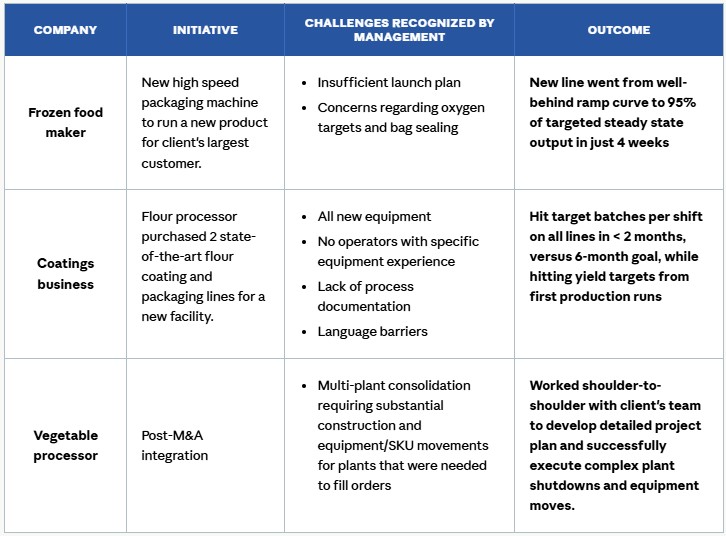
In these situations, third-party support can be a highly value-added route to derisk project execution, particularly when the partner is brought in relatively early. We have experienced this first-hand on multiple occasions where we successfully partnered with client teams to not only achieve the desired outcomes but to do so on-time and on-budget.
Recommendations for resourcing projects
The next time your organization is considering embarking on an important project, ask yourself these questions:
- Can your departmental leaders be allocated to this project full-time? If not, consider what percentage of their time can realistically be freed up without negatively impacting their day-to-day performance. A split focus slows project execution and can quickly turn any initiative into a much longer and more painful journey…while also negatively impacting day-to-day performance. If you’re going to add responsibilities to people’s plates, consider adding resources and/or removing responsibilities to minimize gaps that will otherwise emerge.
- Does your team have the capabilities required to run a project of this magnitude? Large or transformational projects require skills that not all departmental managers possess. Gaps in capabilities don’t stay hidden and cost more to fix than to plan for. Where these gaps exist, third-party support and coaching can help.
- How much actual experience exists inside your team? Has anyone planned and run a project like this before and, if so, what was the outcome? One prior experience can be helpful, but it rarely prepares a person or team for the range of potential issues that routinely emerge in a complex project. The demands are bigger, the interdependencies tighter, and the margin for error smaller.
Conclusions
Trusting your people is important. But sometimes providing your team with targeted third-party support and expertise to supplement their knowledge can help your team look around corners and balance the incremental demands of projects beyond their day-to-day responsibility.
In sum, understanding your team’s availability, capability, and experience up front, and resourcing your project appropriately, will significantly increase the odds of project success.