
Introduction
In most middle market food & beverage manufacturers, the maintenance function is viewed as a cost of doing business, a department focused on fixing equipment when it breaks. But the best food & beverage manufacturers treat maintenance differently. They view reliability as a strategic enabler and a source of competitive advantage, and maintenance as the way to achieve it.
Reliable equipment and manufacturing systems are not just operational necessities. They are fundamental to:
- Achieving consistent, high customer service levels
- Extending useful life of capital assets
- Avoiding or deferring capex
- Reducing finished goods inventory and working capital
- Reducing manufacturing cost and materials loss
- Product conformance and consumer satisfaction
- Employee safety and engagement
In short, investing in improving reliability pays, financially and commercially.
A Tale of Two Manufacturers
To illustrate the difference maintenance philosophy makes, consider two hypothetical mid-sized food & beverage manufacturers with similar product portfolios, equipment, and annual revenues of $100 million.
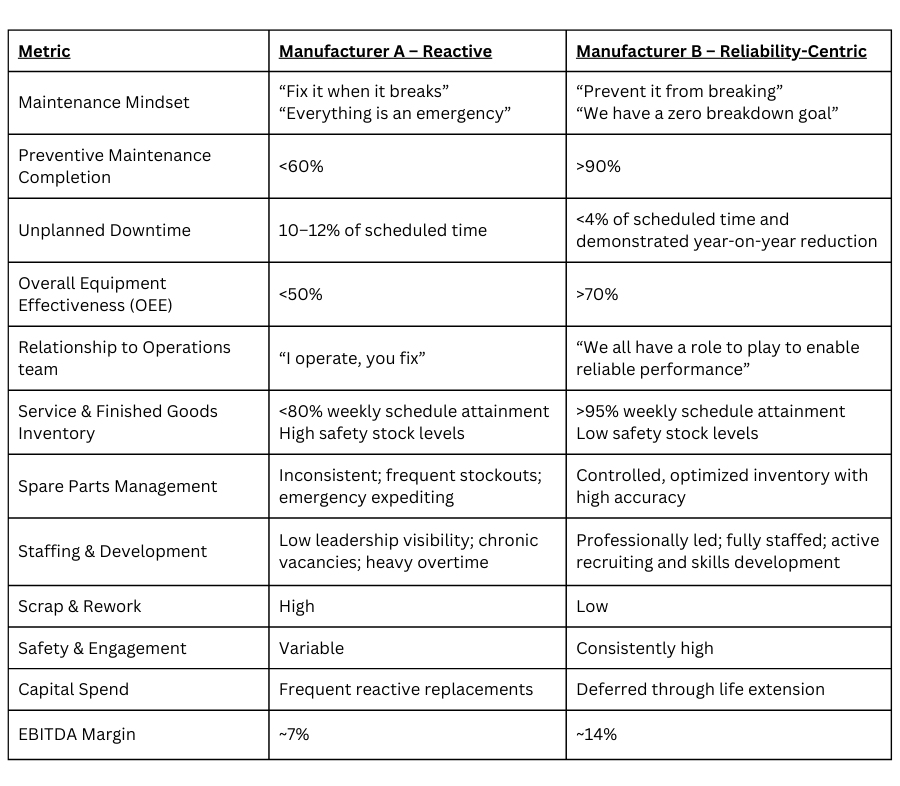
Manufacturer A: “Reactive Maintenance Fix It When It Breaks”
Maintenance is viewed as a cost center. PMs are frequently skipped to “maximize uptime,” work orders are generated only after breakdowns and spare parts management is inconsistent, necessitating expediting spare parts to get equipment back up and running. Maintenance and operations function largely in silos. The department is chronically understaffed, with open roles carried for months. Technicians work excessive overtime to cover shifts, leaving little time for training or improvement work. They lack robust, systematic reliability work processes and sufficient measures of maintenance effectiveness.
Manufacturer B: “Prevent it from breaking – Reliability as Competitive Advantage”
Maintenance is treated as a core business capability. Maintenance is a professionally led organization reporting into the site leader. Leadership invests in preventive and predictive programs, and maintenance performance is managed as rigorously as production or quality. Operators perform routine autonomous maintenance, freeing technicians to focus on reliability improvement and high skilled tasks. Because the function is viewed as critical, the plant actively recruits, trains, and develops its maintenance team to ensure it can serve the plant effectively today and in the future. Maintenance work processes are tracked and performance benefits are measured and reviewed with leadership.
The Competitive Difference
Conclusion
The conclusion is clear: companies that view Maintenance as a strategic advantage rather than a repair function outperform peers in cost, service, safety, quality and capital efficiency.
Maintenance excellence isn’t just about keeping machines running. It’s about building reliability as a capability that drives profitability, agility, and customer trust. Reliability excellence transforms the shop floor from a cost center into a strategic enabler that safeguards employee safety & brand reputation, protects margins, and fuels long-term growth.
Taking the Next Step
At Saphineia, we help manufacturers move from reactive maintenance to reliability-centered performance using a structured Reliability Management System. If you’d like to learn more about how your maintenance program compares and what opportunities may exist in your plants, we’d be happy to discuss our approach.